

Introduction
The T20 World Cup represents the most intense and unpredictable stage in international cricket. Unlike longer formats where patience and endurance dominate, Twenty20 cricket rewards clarity, adaptability, and fearless decision-making. Every ball has consequence, every over changes momentum, and every player must contribute with precision. A team cannot rely only on talent; it must rely on structure, planning, and clearly defined roles.
Building a successful T20 World Cup team is a strategic exercise rather than a simple selection of star players. Modern teams focus on matchups, phase-wise batting plans, specialized bowling roles, and strong fielding units. The format demands explosive scoring in limited time, disciplined death bowling, and calm leadership under pressure. Even small mistakes — a dropped catch, a poor over, or hesitation in batting — can decide the outcome of a match.
This discussion explores the blueprint of an ideal T20 World Cup team: how a balanced lineup is created, how players are assigned responsibilities, and how tactics, preparation, and mentality combine to produce championship performances in the shortest format of the game.
The Philosophy Behind a Winning T20 World Cup Team
The foundation of a successful T20 World Cup team does not begin with selecting the most famous players; it begins with defining how the team wants to win matches. In modern cricket, identity matters more than reputation. A team that understands its playing style performs consistently across different pitches, opponents, and pressure situations.
In the shortest format, hesitation is costly. Unlike Test cricket where mistakes can be corrected over sessions, or ODIs where innings can be rebuilt over time, T20 offers no recovery window. Therefore, the first step in building a strong team is establishing a clear tactical philosophy that every player understands before stepping onto the field.
A well-defined T20 philosophy generally revolves around three central ideas: clarity of roles, proactive decision-making, and controlled aggression.
Clarity of roles means every player knows his exact purpose in the XI. An opener is not selected simply to survive; he is chosen to maximize the powerplay. A middle-order batter is not there just to score runs but to manage tempo. A bowler is either attacking for wickets or containing runs — never both at the same time without intention. When players try to perform roles outside their defined responsibilities, teams lose shape and matches drift away.
Proactive decision-making separates strong T20 sides from average ones. Winning teams do not wait to see what happens; they influence what happens. Captains change fields before boundaries arrive, bowlers vary lengths before batters settle, and batters target specific bowlers rather than reacting randomly. The mindset shifts from responding to controlling.
Controlled aggression is often misunderstood. It is not reckless hitting or constant attacking bowling. Instead, it is calculated risk-taking based on match awareness. For example, attacking a weaker bowler in the seventh over is smart aggression, while attempting the same shot against a specialist death bowler in the twentieth over may be unnecessary risk. Great teams attack at the correct time rather than at all times.
Another important part of philosophy is adaptability. A T20 World Cup is played across different venues — slow pitches, bouncy tracks, spinning conditions, and dew-affected night matches. A rigid team struggles, while a flexible team thrives. Flexibility does not mean changing the entire strategy; it means adjusting execution while preserving core identity.
Communication inside the squad reinforces philosophy. Players must understand not only their own roles but also their teammates’ responsibilities. When an opener knows the number three batter can stabilize after early wickets, he plays more freely. When bowlers trust their death specialist, they attack earlier overs with confidence. Trust creates freedom, and freedom produces performance.
Ultimately, the philosophy of a T20 World Cup team should aim to remove confusion. Pressure already exists in global tournaments — crowds, expectations, knockout stakes — and uncertainty multiplies that pressure. Clear plans simplify decision-making, allowing players to rely on preparation instead of panic.
Before talent, before tactics, and before statistics, a champion team begins with a shared belief about how cricket should be played. Once that belief becomes collective, execution becomes natural and consistency follows.
Constructing the Batting Order: Roles That Control the Game
Once the team philosophy is clear, the next crucial step is designing the batting lineup. In T20 cricket, the batting order is not just a list of players — it is a timeline of intent. Each position represents a phase of the innings, and every phase demands a different mindset. A well-built T20 World Cup team ensures that scoring momentum never collapses from one stage to another.
Instead of thinking from player number one to eleven, teams think from over one to over twenty.
Opening Pair – Setting the Direction
The openers define the match’s emotional tone. The first six overs contain fielding restrictions, making it the most valuable scoring window. But the goal is not blind aggression; it is productive aggression.
An ideal opening partnership contains two contrasting strengths:
One batter applies early pressure through boundary hitting.
The other ensures continuity through strike rotation and smart placement.
This combination prevents bowlers from settling. If both players only attack, early wickets fall. If both defend, the required run rate climbs. Balance allows scoring without panic.
Good openers measure success not only by runs scored but by the condition they leave for the middle order — fewer than two wickets lost and a strong run rate.
Number Three – The Stability Controller
The number three position is the safety valve of a T20 innings. This batter must be prepared to walk in during the first over or the seventh, meaning technique and temperament both matter.
His primary responsibilities:
- Absorb pressure after early wickets
- Maintain scoring tempo
- Build partnerships quickly
He cannot consume too many deliveries, yet he must prevent collapse. In many World Cup matches, this player quietly determines whether a team posts 150 or 185 — a match-winning difference in T20 cricket.
Middle Order (4 & 5) – The Momentum Builders
Overs 7 to 15 often feature spin bowling and spread fields. Many teams slow down here, which is why elite teams win games in this period.
The middle-order batters must excel at:
- Playing spin in all directions
- Rotating strike every over
- Converting singles into twos
- Attacking poor deliveries immediately
They are not required to hit sixes every over; their real job is preventing stagnation. Continuous movement of the scoreboard forces captains to change plans, creating loose balls later.
These batters act as the bridge between the powerplay and the death overs. Without them, the innings collapses into two disconnected halves.
Finishers (6 & 7) – The Match Closers
The last five overs are chaos. Field placements change constantly, bowlers use variations, and pressure peaks. This is where specialist finishers become priceless.
A true finisher possesses rare abilities:
- Hitting yorkers into scoring areas
- Power without long setup time
- Awareness of field placements
- Composure in high-pressure overs
Finishers convert good totals into winning totals. A team scoring 45 runs in the final four overs often wins even after an average start. Conversely, teams lacking finishers frequently waste strong foundations.
Depth also matters. If the batting ends at number six, batters play cautiously. When number eight can contribute, players attack freely.
Flow Over Fame
The biggest mistake teams make is selecting players based on reputation rather than fit. A lineup filled with star players but lacking role distribution struggles under pressure. A balanced order, even with fewer famous names, performs consistently.
A great T20 World Cup batting unit works like a relay race — each player hands momentum to the next. No phase feels like a restart; the innings moves as one continuous surge.
When roles are respected and transitions are smooth, 20 overs feel longer for the opposition and shorter for the batting side — the clearest sign of a well-constructed lineup.
Designing the Bowling Attack: The Core of a T20 World Cup Team
A successful T20 World Cup team is remembered for big sixes and dramatic chases, but tournaments are actually won through bowling structure. Batting wins moments; bowling wins championships. The difference between an average T20 side and a title-winning T20 World Cup team is almost always the quality of overs 1–6 and overs 16–20.
A complete T20 World Cup team does not pick bowlers based only on economy rate or reputation. It builds a bowling unit where every over has a purpose and every bowler controls a specific phase of the match. When the bowling attack is planned phase-by-phase, the captain controls tempo, forces errors, and limits opposition momentum.
To understand a strong T20 World Cup team bowling unit, divide the innings into three operational zones:
Powerplay control → Middle overs squeeze → Death overs execution
Each zone demands a specialist role.
Powerplay Bowlers – Creating Early Damage
In a T20 World Cup team, the powerplay is not about saving runs; it is about taking wickets. Early breakthroughs reduce scoring potential later. Teams that remove two top-order batters inside six overs usually dictate the rest of the innings.
Therefore a balanced T20 World Cup team uses two contrasting new-ball bowlers:
The attacking swing bowler
This bowler aims to dismiss batters, not defend boundaries. He bowls fuller lengths, invites drives, and accepts occasional fours in exchange for wickets. His job is disruption.
The control bowler
This bowler maintains tight lines, prevents easy scoring, and builds pressure from the other end. While one attacks, the other restricts.
A well-built T20 World Cup team never uses two defensive bowlers together in the powerplay. Pressure without wicket threat allows batters to settle. Wicket threat forces mistakes.
Early wickets reshape the entire match — middle-order batters arrive earlier, strike rotation drops, and finishing overs weaken.
Middle Overs Specialists – The Momentum Breakers
Overs 7 to 15 decide whether a team scores 140 or 190. This phase is where a smart T20 World Cup team deploys spin intelligence. Modern cricket analytics show most collapses begin during spin overs because batters become impatient.
A champion T20 World Cup team usually plays at least two different types of spinners:
Attacking spinner – bowls variations in flight and pace to take wickets
Containment spinner – bowls accurate lines to build dot-ball pressure
Together they create scoreboard stagnation. Dot balls in T20 cricket are psychological pressure. After several quiet overs, batters attempt risky shots against pace later.
Middle overs success is not measured by wickets alone. It is measured by forcing batters into bad decisions.
A strong T20 World Cup team exits the 15th over with opposition run rate below 8.5 per over. At that point even explosive hitters struggle to reach a dominant total.
Death Overs Specialists – The Trophy Overs
The final overs define a T20 World Cup team’s legacy. Many teams perform well throughout tournaments but fail in the last three overs of knockout matches. Death bowling is the rarest skill in modern cricket and the most valuable in a T20 World Cup team.
A specialist death bowler must execute:
- Yorkers under pressure
- Slower balls with disguise
- Wide line variations
- Field awareness
Speed alone cannot succeed here. Predictability loses matches. Batters prepare for pace but struggle against late variation.
Great T20 World Cup teams assign overs 17–20 to specific bowlers long before the match begins. Clarity prevents panic decisions. When roles are predefined, bowlers execute with confidence rather than fear.
Teams without death specialists often concede 18–22 runs per over late in the innings — instantly turning a winning position into defeat.
The Sixth Bowling Option – Tactical Insurance
Modern T20 World Cup team planning always includes a sixth bowler. Conditions, matchups, or a bad day from a main bowler can disrupt plans. A reliable extra option allows the captain to react instantly.
This bowler might be:
- A batting all-rounder
- A part-time spinner against specific batters
- A pace variation option on slow pitches
The sixth option transforms flexibility into advantage. Without it, captains are forced to complete overs with struggling bowlers.
Bowling Partnerships, Not Individuals
A T20 World Cup team succeeds when bowlers operate as partnerships. One bowler attacks while another builds pressure. One over slows scoring while the next hunts wickets. The goal is rhythm disruption.
Opposition batters should never face the same pace, angle, or speed for consecutive overs. Variation creates uncertainty, and uncertainty produces mistakes.
The Bowling Identity of a Champion Team
Every winning T20 World Cup team shares bowling characteristics:
- Early wickets in most matches
- Middle-overs run-rate control
- Reliable final overs
- Multiple bowling combinations
Batting may win highlights, but structured bowling wins tournaments. When a T20 World Cup team controls all twenty overs instead of reacting to them, the match feels shorter for them and longer for opponents.
A powerful batting lineup excites fans, yet a disciplined bowling unit lifts the trophy.
All-Rounders and Team Balance: The Engine of a Complete T20 World Cup Team

A truly competitive T20 World Cup team is not built only around batters and bowlers — it is built around balance. Balance is what allows a captain to react instantly, adapt to conditions, and recover from bad situations. In modern T20 cricket, the presence of quality all-rounders transforms an ordinary playing XI into a flexible and unpredictable unit.
Many teams enter tournaments with strong top orders and impressive bowling attacks, yet they struggle when matches deviate from the expected script. A sudden collapse, an injured bowler, dew on the pitch, or an unexpected batting matchup can expose rigid teams. A balanced T20 World Cup team, however, absorbs chaos because it has multiple skill layers.
At the heart of this balance are all-rounders.
Why All-Rounders Define a T20 World Cup Team
In the shortest format, overs and batting positions are limited resources. An all-rounder effectively gives a team an extra player because he contributes in two departments. One genuine all-rounder strengthens the XI — two genuine all-rounders redefine the team’s strategy.
A well-constructed T20 World Cup team typically includes:
- A batting all-rounder (top or middle order support)
- A bowling all-rounder (overs insurance and late hitting)
This structure creates depth. Batters can attack earlier knowing the lineup continues. Bowlers can be rotated aggressively without fear of running out of options.
Depth removes hesitation — and hesitation is the biggest enemy in T20 cricket.
Batting Depth and Fearless Approach
One of the biggest advantages of a balanced T20 World Cup team is batting freedom. When the number seven and number eight players can score runs, the top order plays naturally instead of cautiously.
Without depth:
- Openers protect wickets
- Middle order delays acceleration
- Finishers face excessive pressure
With depth:
- Openers attack powerplay bowlers
- Middle order rotates aggressively
- Finishers play calculated shots
This psychological difference often adds 20–25 extra runs — the margin that wins knockout matches.
Bowling Flexibility and Matchups
All-rounders also create tactical bowling freedom. In a long tournament like the T20 World Cup, conditions vary drastically. Some pitches help spin, others favor pace, and some demand cutters and variations.
A balanced T20 World Cup team can adjust instantly:
- Extra spin overs on slow surfaces
- Extra seam overs under lights
- Shorter spells for struggling bowlers
- Targeting specific opposition batters
Instead of forcing bowlers to complete their quota, the captain uses bowlers strategically. This prevents one bad over from deciding the match.
Injury and Form Protection
World Cup tournaments are intense and compact. Fatigue, minor injuries, and form dips are inevitable. Teams dependent on fixed specialists suffer when one player underperforms.
All-rounders act as insurance.
If a bowler has a bad day, an all-rounder completes overs.
If a batter struggles, an all-rounder stabilizes the innings.
Thus the team structure remains stable even when individuals fluctuate — a defining trait of successful T20 World Cup teams.
Fielding Energy and Athleticism
Another overlooked advantage of all-rounders in a T20 World Cup team is fielding quality. Most all-rounders are naturally athletic because they train in multiple disciplines. This improves:
- Boundary protection
- Run-out opportunities
- Catch conversion rate
In T20 cricket, saving 12 runs in the field equals scoring 12 runs with the bat. Balanced teams consistently win these invisible battles.
The Ideal Balance Combination
An ideal T20 World Cup team composition often resembles:
- 6 genuine batting options
- 2 batting all-rounders
- 4–5 bowling options
- 1 bowling all-rounder
- Multiple part-time overs
This structure ensures the captain always has options. Predictability disappears, and adaptability becomes natural.
Balance Creates Confidence
More than tactics, balance builds belief. Players perform better when they know the team does not collapse after one mistake. Confidence spreads across the lineup — bowlers attack, batters commit to shots, and fielders stay alert.
A balanced T20 World Cup team does not fear match situations because it always has another solution available.
In modern cricket, talent wins games, but structure wins tournaments. And structure comes from balance — the silent force behind every championship campaign.
Fielding and Fitness: The Silent Match Winners in a T20 World Cup Team
In modern cricket, a T20 World Cup team is no longer judged only by batting power or bowling variety. The biggest difference between a good team and a champion team is often found in the field. Fielding does not create headlines like a century or a hat-trick, yet across a tournament it quietly decides multiple matches.
In a 20-over game, every run has amplified value. Saving 15 runs in the field is equal to scoring a quick 15 with the bat. Over several matches, this hidden contribution becomes the margin between qualification and elimination.
A serious T20 World Cup team therefore treats fielding as a primary skill, not a supporting one.
The Direct Impact of Fielding on Match Results
There are three major fielding moments that repeatedly change T20 games:
Catches – Dropping one key batter often costs 30–40 runs
Run-outs – Instant momentum shift without using a delivery
Boundary saves – Preventing fours converts pressure back to the batter
Because the format is short, teams rarely get recovery time after mistakes. A dropped catch in the 8th over may decide the match in the 20th over. Championship teams understand this connection and maintain intensity for all 120 deliveries.
Inner Circle Specialists
The first ring inside the circle is the busiest zone in T20 cricket. Singles are constantly attempted here to rotate strike. A strong T20 World Cup team places its fastest reflex fielders in these positions.
Their responsibilities include:
- Diving stops to prevent easy singles
- Quick release throws to pressure batters
- Creating half-chances for run-outs
When batters cannot rotate strike, they attempt risky shots. This creates wickets without bowlers needing special deliveries.
Boundary Riders – The Run Protectors
Outfielders on the boundary save more runs than any other position. Athletic movement and powerful throwing arms are essential.
Great boundary fielders provide three advantages:
- Convert sixes into twos
- Stop certain fours
- Execute long-distance run-outs
Over a World Cup campaign, strong boundary work alone can reduce opposition totals by 20–30 runs per match — a massive difference in T20 cricket.
The Wicketkeeper’s Expanded Role
In a modern T20 World Cup team, the wicketkeeper is no longer just a catcher. He is a tactical communicator. Standing close to the batter, he constantly reads angles, suggests field adjustments, and observes batters’ movements.
A high-quality keeper contributes through:
- Lightning stumpings against spin
- Immediate feedback to bowlers
- Organizing field placements
This turns the keeper into the captain’s second strategist on the field.
Fitness: The Foundation of Consistent Performance
Fielding excellence cannot exist without elite fitness. T20 tournaments involve frequent travel, short recovery time, and high-intensity matches. Fatigue leads to slower reactions, weaker throws, and poor decision-making.
An elite T20 World Cup team prioritizes:
- Sprint endurance for quick singles
- Core strength for powerful hitting
- Shoulder strength for accurate throws
- Agility for fast direction changes
Fitness also affects batting and bowling quality late in matches. A tired bowler misses yorkers. A tired batter mistimes shots. A tired fielder drops catches. Energy management across the tournament becomes a competitive advantage.
Pressure Through Energy
One overlooked aspect of fielding is psychological pressure. When a team moves faster, throws sharper, and celebrates together, opponents feel rushed. Batters misjudge runs, hesitate, and attempt low-percentage strokes.
Energy is contagious. A lively T20 World Cup team forces errors without changing tactics — simply through visible intensity.
Why Champions Excel in the Field
Across T20 tournaments, champion teams consistently rank among the best fielding sides. Their success is not accidental. They understand that skill and strategy create opportunities, but fielding converts those opportunities into results.
Runs saved accumulate. Chances taken multiply. Momentum shifts repeatedly.
In a format decided by small margins, the sharpest fielding team often lifts the trophy.
Captaincy and Decision-Making: The Brain of a T20 World Cup Team
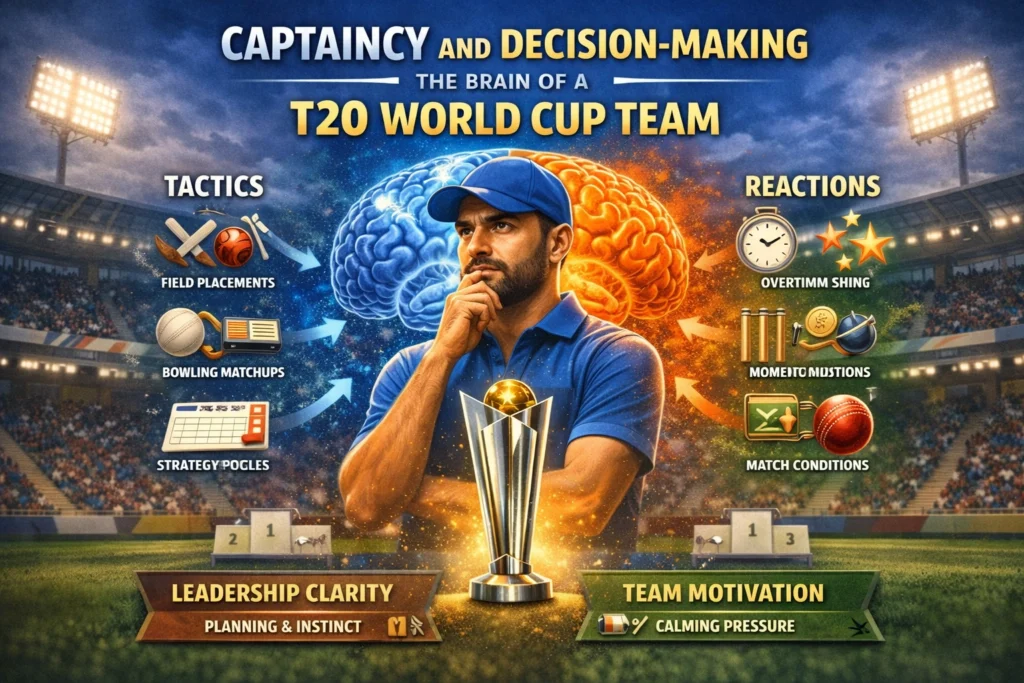
In a high-pressure tournament, the quality that most defines a T20 World Cup team is not talent — it is leadership. The captain in T20 cricket does far more than toss decisions or field placements. He controls rhythm, manages emotions, and turns plans into real-time actions within seconds.
Unlike longer formats, a T20 match moves too quickly for long discussions. A single over can swing the entire game. Therefore the captain’s thinking speed becomes as important as the players’ skill level. The best T20 World Cup teams are usually led by captains who anticipate situations rather than react to them.
Reading the Game Before It Happens
Great T20 captaincy is predictive. Instead of waiting for a batter to dominate, the captain identifies warning signs early:
- A batter repeatedly stepping outside leg stump
- A bowler losing yorker accuracy
- A pitch suddenly slowing down
- A new batter struggling against spin
When the captain acts before damage occurs, pressure stays on the opposition. When he reacts late, momentum shifts permanently.
The strongest T20 World Cup team leaders constantly think two overs ahead — not one ball behind.
Bowling Changes: The Ultimate Tactical Tool
Bowling rotation is the captain’s most powerful weapon. In T20 cricket, the same bowler can look unplayable in one matchup and predictable in another. Smart captains use bowlers like chess pieces rather than fixed sequences.
Effective captains:
- Hold back overs for specific batters
- Introduce spin immediately after power hitters arrive
- Use part-time bowlers unexpectedly
- Protect struggling bowlers without damaging confidence
A well-timed bowling change often produces wickets without extraordinary deliveries — simply because the batter was not prepared for it.
Field Placements and Micro-Adjustments
Every ball in a T20 match offers new information. Elite captains adjust fields constantly, sometimes after a single delivery.
Examples include:
- Moving a fielder squarer after one pull shot
- Bringing the circle in to force aerial shots
- Protecting boundaries for slower balls
- Opening gaps intentionally to tempt risky runs
These micro-adjustments create psychological traps. Batters feel scoring options disappearing and attempt low-percentage shots.
A disciplined T20 World Cup team follows field signals instantly, turning small tactical ideas into real pressure.
Managing Player Emotions
Pressure in a World Cup is intense — crowds, expectations, and knockout consequences amplify every moment. The captain’s behavior directly influences team composure.
Calm captains create calm teams.
Panicked captains create rushed decisions.
Strong leaders communicate clearly after mistakes. Instead of showing frustration after a dropped catch or expensive over, they reset focus. This emotional stability ensures players execute skills rather than overthinking outcomes.
Confidence spreads from leadership faster than from performance.
Batting Order Flexibility
Modern T20 captaincy also extends to batting strategy. Fixed batting positions often fail in changing matchups. Flexible leaders promote or delay batters depending on conditions:
- Sending a spin hitter against multiple spinners
- Promoting a power hitter during required run-rate spikes
- Holding a finisher for the final overs
- Stabilizing the innings after quick wickets
This adaptability prevents the opposition from planning comfortably.
The Captain as the On-Field Analyst
While analysts and coaches prepare data before matches, the captain interprets it live. Conditions may differ from expectations — dew arrives early, the pitch slows faster, or wind affects lengths. The captain converts preparation into action.
A great T20 World Cup team trusts its captain’s instincts as much as its strategies.
Leadership Defines Championship Moments
In knockout games, skills between teams are often equal. The difference appears in one decision:
- Choosing the right bowler for the 19th over
- Changing field before a boundary
- Promoting the correct batter at the right time
These moments rarely look dramatic, yet they decide trophies.
Ultimately, the captain is the system that connects preparation, talent, and execution. A well-led T20 World Cup team performs above individual ability because clarity replaces doubt.
When pressure peaks and margins shrink, leadership becomes the decisive advantage.
Tournament Strategy and Adaptability: Surviving the T20 World Cup Journey
A bilateral series tests skill, but a global tournament tests survival. A true T20 World Cup team is not only built to win matches — it is built to endure conditions, schedules, and psychological swings across several weeks. Many strong teams dominate early games yet fail in knockout rounds because they cannot adapt to changing demands.
Winning the T20 World Cup requires long-term planning across three stages:
Group stage consistency → Super stage flexibility → Knockout composure
Each stage demands a slightly different approach.
Group Stage – Stability First
In the early matches, the goal of a T20 World Cup team is control rather than experimentation. Teams should rely on their strongest combination and secure qualification points quickly. Constant changes during this phase create uncertainty and disrupt rhythm.
Key priorities during group matches:
- Fixed opening combination for confidence
- Defined bowling roles for clarity
- Simple tactics instead of risky innovations
The objective is momentum. Early victories reduce pressure later and allow strategic adjustments without desperation.
A team that qualifies early enters the next stage mentally fresh.
Super Stage – Tactical Flexibility
Once stronger opponents appear, adaptability becomes essential. Different venues and teams require new combinations. This is where squad depth proves valuable.
A prepared T20 World Cup team may adjust:
- Extra spinner on slow pitches
- Extra pacer on bouncy surfaces
- Left-right batting combinations against specific attacks
- Bowling matchups targeting key opposition batters
Instead of changing the entire playing style, teams modify supporting roles around their core identity. Consistency remains, but execution evolves.
Successful teams treat each match as a new puzzle rather than repeating a single formula.
Knockout Matches – Pressure Management
Knockout games are psychologically different from league matches. The fear of elimination often causes hesitation — batters slow down and bowlers become defensive. However, history shows conservative play rarely wins T20 knockouts.
A champion T20 World Cup team maintains its natural approach:
- Attack during powerplay
- Use wicket-taking bowlers early
- Trust finishers at the death
Changing philosophy due to pressure leads to confusion. Trusting preparation produces clarity.
In knockout matches, mental strength outweighs tactical complexity. Teams must focus on execution rather than consequence.
Handling Conditions and External Factors
World Cups are played across multiple venues, meaning playing conditions change rapidly. A prepared T20 World Cup team studies environmental influences carefully:
Pitch type – dry, grassy, or slow
Weather – humidity affecting swing and dew
Ground size – small boundaries favoring power hitters
Match timing – day vs night behavior
Teams that read conditions faster gain immediate advantage. For example, recognizing early dew might encourage chasing instead of defending.
Adaptability is not about frequent changes — it is about correct changes.
Squad Rotation and Player Energy
Fatigue is a silent opponent in long tournaments. Continuous travel and high-intensity matches reduce sharpness. Smart teams manage workload without losing stability.
Selective rotation can:
- Keep fast bowlers fresh
- Maintain fielding energy
- Prevent injuries
The goal is freshness during knockout matches rather than exhaustion after group dominance.
Learning During the Tournament
Every match offers information — how pitches behave, how opponents plan, and how players respond under pressure. The best T20 World Cup team evolves during the competition.
They review:
- Successful batting patterns
- Effective bowling variations
- Opponent weaknesses
This learning curve ensures the team becomes stronger as the tournament progresses, not predictable.
The Importance of Momentum
Confidence grows with consecutive wins. Momentum reduces overthinking and encourages instinctive play. Teams entering semifinals on winning streaks often perform better than teams that qualify nervously in the last match.
Therefore, maintaining positive energy inside the squad becomes part of strategy.
Winning the Long Game
The T20 World Cup is not won in one brilliant match but across multiple controlled performances. A team that manages pressure, adapts conditions, preserves energy, and trusts its core philosophy survives every stage.
The champion T20 World Cup team is not the most explosive — it is the most resilient.
The Mental Game: Confidence, Nerves, and Championship Temperament
Skill, strategy, and preparation shape a strong T20 World Cup team, but the final difference between champions and contenders is mental strength. In the shortest format, matches are decided in moments — a single over, a single catch, a single decision. When pressure rises, technique alone cannot guarantee execution. The mind controls the body.
Every T20 World Cup produces similar scenes: experienced players mistiming simple shots, reliable bowlers missing lengths, and teams collapsing despite strong positions. These are rarely technical failures. They are pressure reactions.
A team that masters its mindset gains a decisive advantage before the first ball is bowled.
Understanding Pressure in T20 Cricket
Pressure in T20 cricket builds faster than in any other format because time is limited. Batters cannot wait for form, and bowlers cannot recover from repeated mistakes. The scoreboard constantly demands action.
Typical pressure triggers include:
- High required run rate
- Defending a small total
- Knockout match situations
- Facing a specific star opponent
An unprepared T20 World Cup team reacts emotionally — rushing shots, forcing yorkers, misjudging runs. A mentally trained team reacts logically — focusing only on the next ball.
The difference lies in awareness.
Role Clarity Reduces Anxiety
Confusion increases pressure. When players are unsure of expectations, they overthink decisions. Clear roles solve this problem.
If a finisher knows his job is to attack from ball one, he does not worry about strike rate later.
If a bowler knows he is chosen to take wickets, he accepts boundaries while attacking.
Clarity replaces doubt with purpose. That is why successful T20 World Cup teams repeatedly emphasize simple responsibilities rather than complex instructions.
Handling High-Pressure Overs
The most stressful moments in T20 cricket usually occur in:
- The final over of a chase
- The penultimate over while defending
- After losing quick wickets early
Teams train specifically for these scenarios through repetition. Practicing simulated pressure helps players treat real situations as familiar rather than frightening.
Players who have “experienced” pressure before react calmly when it truly arrives.
The Power of Collective Belief
Confidence spreads quickly within a team environment. When players trust each other’s ability, individual mistakes do not damage morale. Instead of panic, the group resets and focuses forward.
Signs of a confident T20 World Cup team:
- Positive body language after setbacks
- Encouragement instead of criticism
- Consistent intensity throughout innings
Opponents notice this composure. Pressure subtly transfers to the other side.
Momentum and Emotional Control
T20 matches swing rapidly. A boundary, wicket, or run-out can change energy instantly. Successful teams do not ride emotions excessively — they stabilize quickly after both success and failure.
Celebrating excessively may reduce concentration. Showing frustration may encourage opponents. Emotional balance keeps decision-making clear.
The calmest team usually executes skills more accurately in decisive overs.
Trusting Instinct Over Fear
In crucial moments, players often hesitate because they fear mistakes. Yet T20 cricket rewards commitment. A half-hearted shot or uncertain delivery is easier to counter than a fully committed action.
Championship teams encourage decisive choices:
- Commit fully to attacking strokes
- Deliver variations confidently
- Run decisively between wickets
Even when outcomes fail, conviction prevents collapse in performance.
Experience vs Preparation
Experience helps, but preparation matters more. Young teams have won global tournaments by rehearsing scenarios thoroughly. Knowing exactly what to do removes intimidation.
Preparation builds artificial experience — allowing players to perform like veterans under pressure.
The Mental Edge in Knockouts
In knockout matches, technical gaps between teams are minimal. The difference appears in composure:
- One team focuses on outcome
- The other focuses on process
The team focused on process executes naturally and wins critical moments.
Winning the Invisible Battle
The mental aspect of a T20 World Cup team cannot be measured statistically, yet it influences every statistic. Strike rate, economy rate, and fielding efficiency all improve when players are calm and confident.
Ultimately, cricket at the highest level becomes a contest of clarity under chaos. The team that remains mentally organized while the match becomes unpredictable lifts the trophy.
Champions are not fearless because pressure is absent — they are fearless because pressure is understood and controlled.
The Role of Data and Analysis in a Modern T20 World Cup Team
Cricket has entered an analytical era, and every successful T20 World Cup team now combines instinct with information. Numbers alone do not win matches, but ignoring them leaves a team unprepared. The modern approach is balance — using data to guide decisions while allowing players to execute freely.
T20 cricket produces enormous amounts of measurable detail. Every ball reveals patterns: scoring areas, preferred lengths, boundary percentages, and dismissal methods. Teams that study these patterns gain predictive advantage before stepping onto the field.
Pre-Match Planning Through Data
Before each game, analysts study opposition behavior carefully. Instead of general strategies, teams prepare specific plans for individual batters and bowlers.
Common analytical insights include:
- A batter scoring heavily on short balls but struggling against wide yorkers
- A bowler conceding boundaries when batters move across the crease
- A player rotating strike poorly against left-arm spin
- A finisher favoring one side of the ground under pressure
With this knowledge, the T20 World Cup team enters the match already understanding where risks and opportunities lie.
Preparation turns uncertainty into structure.
Matchups: The Core of T20 Strategy
Modern T20 cricket revolves around matchups — selecting the right bowler against the right batter. A medium-pace bowler may outperform a fast bowler simply because the batter prefers pace. A part-time spinner might dismiss a power hitter who struggles against spin variations.
Instead of asking, “Who is our best bowler?” teams now ask, “Who is best against this batter right now?”
This situational thinking allows captains to:
- Delay certain bowlers until specific batters arrive
- Promote batters to attack favorable bowlers
- Avoid unfavorable combinations
Matchups transform T20 cricket into a strategic contest rather than a purely physical one.
Field Placement Optimization
Data also guides field positioning. Analysts map scoring zones to identify where batters hit most frequently. Fielders are then placed not traditionally, but statistically.
For example:
- Extra cover moved squarer for inside-out hitters
- Fine leg placed finer for scoop shots
- Deep midwicket wider against slog sweepers
These adjustments may save only a few runs per match, but across a tournament they create decisive margins.
Bowling Length and Variation Patterns
Numbers reveal optimal lengths on different pitches. On some surfaces, slightly shorter balls succeed; on others, full deliveries produce wickets. Teams adjust quickly using early overs as data collection.
Bowlers also track which variations work best:
- Slower cutters on dry pitches
- Hard lengths on bouncy surfaces
- Yorkers under dew conditions
Instead of guessing, execution becomes informed.
Batting Strategy Through Analytics
Batters use analysis to plan scoring routes. Rather than attacking randomly, they identify overs to target. A T20 World Cup team may aim to score heavily against one particular bowler while safely negotiating another.
This controlled aggression ensures consistent run rates without reckless risk.
Batters also study field patterns to anticipate scoring gaps before the ball is delivered.
Real-Time Adaptation
While pre-match plans matter, live adjustment matters more. Analysts and coaching staff constantly communicate observations:
- Change in pitch pace
- Unexpected swing
- Dew affecting grip
The captain then converts these observations into on-field changes. A flexible T20 World Cup team treats data as a living tool rather than a fixed instruction.
Avoiding Over-Dependence
Despite its value, overusing statistics can reduce natural instincts. Players must not become mechanical. T20 cricket still requires creativity — improvisation, innovation, and courage in unfamiliar situations.
The best teams use data for preparation but rely on awareness during play.
Information supports intuition; it should not replace it.
Intelligence as Competitive Advantage
When two teams possess similar talent, smarter decision-making decides the result. Analytical clarity helps players act faster, reducing hesitation in crucial moments.
A modern T20 World Cup team therefore blends three elements:
Preparation from data
Execution through skill
Adjustment through instinct
This combination transforms strategy into performance.
In contemporary cricket, physical ability starts the contest — intelligent planning finishes it.
What Ultimately Wins a T20 World Cup
After all discussions about batting depth, bowling roles, leadership, fitness, and analytics, one final question remains: what truly makes a T20 World Cup team lift the trophy? History repeatedly shows that no single factor guarantees victory. Championships are not won by talent alone, nor by strategy alone. They are won when multiple elements peak together at the right time.
A World Cup is a short tournament, and short tournaments reward timing more than long-term dominance. The best team on paper does not always win — the best performing team in key moments does.
Peaking at the Right Moment
Group stage performance builds confidence, but knockout performance decides champions. Many teams dominate early matches yet struggle under elimination pressure. Successful T20 World Cup teams gradually improve as the tournament progresses.
Signs of a peaking team include:
- Batters finding rhythm late in the competition
- Bowlers executing plans consistently in final matches
- Fielding intensity increasing rather than dropping
Momentum at the end matters more than brilliance at the beginning.
Trust in Defined Roles
Winning teams rarely panic. Even after losing quick wickets or conceding runs, they trust their structure. Players continue performing assigned responsibilities instead of attempting heroic improvisations.
For example:
- Anchors keep rotating strike instead of hitting rash shots
- Finishers wait for their overs rather than forcing acceleration early
- Strike bowlers attack even after boundaries
Consistency of approach prevents collapses under pressure.
Courage Over Caution
Knockout matches tempt teams to play safely. However, defensive cricket often invites defeat in T20 format. Champions maintain controlled aggression regardless of match situation.
They:
- Attack during powerplay instead of merely surviving
- Look for wickets rather than defending totals
- Back skill instead of fearing mistakes
Bravery backed by preparation becomes advantage, while hesitation becomes vulnerability.
Small Moments Decide Big Matches
In a T20 World Cup, finals are rarely won by huge margins. Instead, small incidents accumulate:
- A direct-hit run-out
- A saved boundary
- One successful review
- A well-timed bowling change
These moments rarely appear dramatic individually but collectively determine outcomes. The best teams remain alert for every ball, treating each action as match-defining.
Collective Contribution
Championship teams rarely rely on one superstar throughout the tournament. Different players step up in different matches:
- One batter rescues a collapse
- Another finishes a chase
- A bowler defends a tight over
- A fielder produces a decisive run-out
Shared responsibility keeps pressure distributed across the squad.
Emotional Control in Finals
Final matches carry enormous expectation. The louder the environment, the more important composure becomes. Teams that treat the final like another match execute skills naturally. Teams overwhelmed by occasion lose clarity.
The champion T20 World Cup team simplifies thinking:
Focus on the next ball
Ignore the scoreboard noise
Trust preparation
This mental discipline allows performance to remain stable while stakes rise.
The Complete Formula
Ultimately, lifting the trophy requires the combination of:
- Balanced squad structure
- Clear strategy
- Adaptive leadership
- Strong fielding effort
- Mental resilience
Remove one element and the campaign weakens. Align all elements and the team becomes extremely difficult to defeat.
The Essence of a Champion
The winning T20 World Cup team is not perfect in every match. It may struggle, recover, and adapt repeatedly. What separates it from others is belief in its method even during uncertainty.
When preparation meets courage at the decisive moment, performance becomes natural rather than forced.
That is the point where a team stops chasing the trophy — and becomes worthy of holding it.
Conclusion: The Identity of a True T20 World Cup Team
A great T20 World Cup team is not measured by how many star players appear on the team sheet, but by how perfectly those players function together within a clear system. Modern cricket rewards planning, structure, and awareness more than individual brilliance. Teams that understand their identity perform consistently, while teams that depend only on talent struggle when pressure rises.
Throughout a tournament, conditions shift, opponents change, and expectations grow heavier. Only a side built on balance adapts without losing confidence. Batters recognize when to accelerate and when to rotate strike. Bowlers understand whether their role is attacking for wickets or restricting runs. Fielders maintain intensity because they know saving ten runs can be as valuable as scoring ten runs.
The preparation phase shapes everything. Selection builds balance, strategy builds direction, and practice builds reaction speed. Once the competition begins, trust becomes the most important resource — trust in roles, teammates, and the overall plan. When difficult situations appear, this trust prevents panic and keeps performance steady.
A championship campaign rarely depends on one superstar performance. Different players contribute in different matches: a stabilizing partnership in one game, a decisive final over in another, and a crucial catch in a knockout. Small moments collectively define the journey to the trophy.
Leadership connects the entire structure. A calm captain provides clarity, and clarity allows players to focus on execution rather than consequences. When pressure peaks, the best teams simplify the game — watch the ball, commit to the skill, and follow preparation.
Modern cricket analysis and match insights available on external platforms like yoiplnews help fans understand evolving match situations, while detailed cricket breakdowns and team strategy discussions can be explored internally at kheloyaar. These perspectives reinforce how preparation and awareness influence results at the highest level.
Ultimately, the T20 World Cup rewards teams that combine aggression with discipline and confidence with control. Talent opens the door, but organization carries the team across the finish line. The side that understands the format completely does not chase victory — it naturally arrives at it.
Frequently Asked Questions (FAQ)
1. What makes a strong T20 World Cup team?
A strong T20 World Cup team is built on balance, clear player roles, adaptable strategy, and mental composure. It requires aggressive batting, specialized death bowling, athletic fielding, and smart leadership rather than only big-name players.
2. How important are all-rounders in a T20 World Cup team?
All-rounders are extremely important because they provide batting depth and bowling flexibility. They allow captains to adjust strategies based on match situations and reduce pressure on specialist players.
3. Why is death bowling crucial in T20 cricket?
Death bowling decides close matches. The final overs often determine the result, and teams with accurate yorkers and slower-ball variations usually defend totals successfully.
4. What role does the captain play in T20 matches?
The captain controls match tempo through bowling changes, field placements, and batting order adjustments. Quick decision-making and calmness under pressure are essential leadership qualities in T20 cricket.
5. How does fielding impact T20 World Cup games?
Fielding saves runs, creates run-outs, and converts half-chances into wickets. Since matches are short, even small fielding improvements can change the final outcome.
6. Do statistics and analytics matter in T20 cricket?
Yes, modern teams use analytics to plan matchups, target weak bowlers, and set fields. However, data supports decisions — players still rely on instinct during live match situations.
7. Why do some strong teams fail in knockout matches?
Teams often fail due to pressure and changing their natural playing style. Successful teams stick to their approach and trust preparation rather than playing overly cautiously.
8. Is batting or bowling more important in T20 World Cups?
Both matter, but bowling consistency often wins tournaments. Teams that control runs and take wickets regularly perform better than teams relying only on big scores.
9. How does team balance affect performance?
Balanced teams handle unexpected situations better — collapses, injuries, or difficult pitches. Depth in batting and multiple bowling options increase winning probability.
10. What is the biggest factor in winning a T20 World Cup?
The biggest factor is performing well under pressure at the right time. Teams that peak during knockout matches and maintain clarity in decision-making usually become champions.