

Introduction to Live Sports Betting
Live sports betting has redefined the way fans experience competitive games across the world. Instead of placing a wager before kickoff and waiting for the final result, bettors can now engage with matches as they unfold in real time. Every goal, point, wicket, touchdown, or momentum shift creates a fresh opportunity. This dynamic format has turned sports viewing into an interactive, fast-paced experience where decisions are made within seconds.
Unlike traditional betting, live sports betting operates on constantly changing odds. These odds respond instantly to what is happening on the field, court, or pitch. A single goal in football, a three-pointer in basketball, or a break of serve in tennis can dramatically shift probabilities. This fluid environment demands attention, quick thinking, and strong game awareness.
The rapid growth of mobile technology and advanced data analytics has fueled the popularity of live sports betting. With smartphones and real-time streaming, bettors can monitor statistics, track performance trends, and place wagers from virtually anywhere. Modern platforms update odds within seconds, making the experience seamless and immersive.
However, live sports betting is not just about speed and excitement. It also requires discipline and strategy. Successful participants analyze momentum, understand game dynamics, and manage their bankroll carefully. While the thrill is undeniable, responsible participation remains essential.
In today’s sports culture, live sports betting has become more than a trend—it is a major evolution in sports entertainment. It blends technology, strategy, and adrenaline into a continuous real-time engagement that keeps fans connected until the final whistle.
How Live Sports Betting Platforms Operate in Real Time
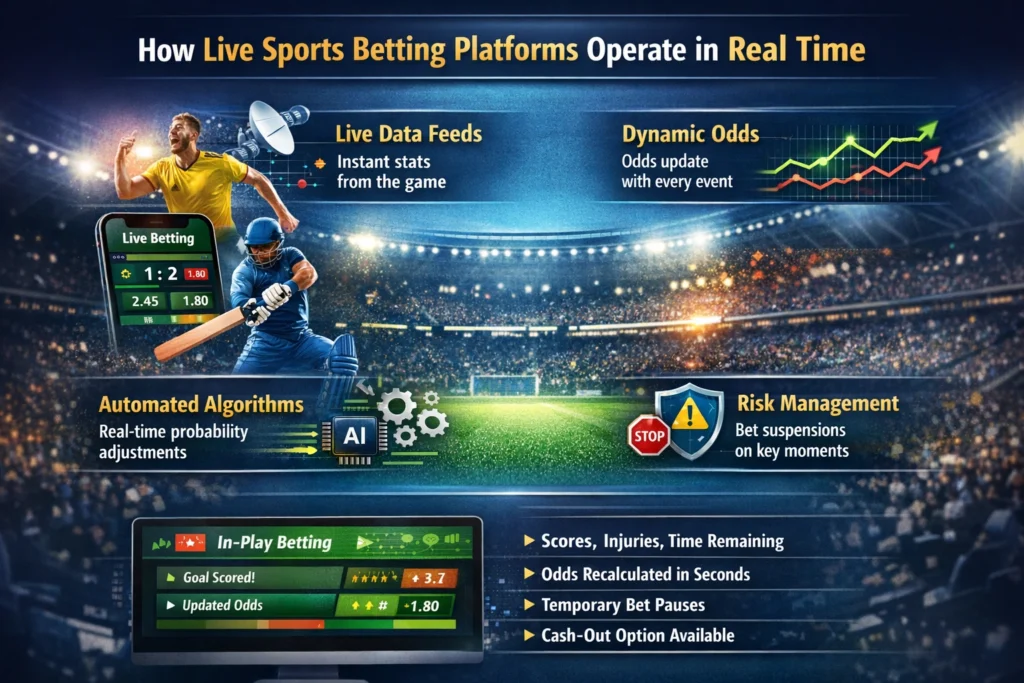
Live sports betting platforms function through advanced real-time data systems that constantly monitor and process match events. Unlike traditional betting systems that rely only on pre-game analysis, live platforms depend on instant data feeds, probability models, and automated risk management tools.
When a sporting event begins, the system activates dynamic markets. These markets continuously update based on live match statistics such as score changes, possession percentages, player substitutions, injuries, fouls, time remaining, and momentum swings. Within seconds of a major event—like a goal in football or a break of serve in tennis—the odds are recalculated and displayed to users.
To maintain accuracy, most platforms use:
- Real-time data feeds from official sports providers
- Automated algorithms that adjust probabilities instantly
- Risk management tools to prevent extreme liability
- Temporary bet suspensions during critical moments
For example, if a football team receives a red card, betting may briefly pause. During this pause, the system recalculates new odds reflecting the team’s reduced chances of winning. Once updated, betting reopens with adjusted prices.
Another important feature is the cash-out option. This allows bettors to settle a wager before the match ends. If the game is moving in their favor, they can secure a partial profit. If momentum shifts, they can minimize losses. This flexibility is one of the biggest differences between live sports betting and traditional betting formats.
Speed is essential in live sports betting. A delay of even a few seconds can change value opportunities. That is why many serious participants prefer watching matches through low-latency streams or live broadcasts instead of relying solely on score updates.
In addition, user interface design plays a crucial role. Platforms organize markets by:
- Main outcome (win/lose/draw)
- Totals (over/under points or goals)
- Player performance bets
- Next event predictions
- Micro-markets (next point, next card, next over)
This structured layout helps users make faster decisions without confusion during high-pressure moments.
Ultimately, live sports betting platforms are built on speed, automation, and precision. They combine technology, mathematics, and sports analytics to deliver a seamless real-time wagering experience.
The Role of Strategy in Live Sports Betting
Live sports betting may appear fast and instinct-driven, but long-term success depends heavily on strategy. Because odds shift constantly, bettors must think analytically while staying calm under pressure. Unlike pre-match betting, where decisions are made after careful research, live betting requires quick evaluation combined with solid preparation.
One of the most effective approaches is pre-game planning. Experienced bettors often analyze teams, player form, historical trends, and tactical styles before the match begins. This preparation allows them to identify potential in-play opportunities. For example, if two high-scoring teams are facing each other but the first half ends 0–0, there may be value in second-half goal markets.
Another important strategy is understanding game flow. Momentum matters significantly in live sports betting. A team dominating possession or creating repeated scoring chances may offer strong value even if they are not yet leading. Observing pressure, fatigue, defensive organization, and substitutions can provide insights that raw statistics alone might miss.
Timing is also critical. Entering a market too early can reduce value, while waiting too long may cause odds to disappear. Successful bettors look for balanced entry points—moments when the odds still offer potential but risk is manageable. This often requires patience rather than reacting emotionally to every event.
Bankroll management remains the foundation of any live betting strategy. Because live markets provide continuous opportunities, it can be tempting to place multiple wagers in quick succession. Setting fixed stake sizes and daily limits helps prevent impulsive decisions. Discipline protects long-term sustainability.
Another smart approach is selective betting. Instead of betting on every match available, focusing on specific leagues or sports improves understanding and prediction accuracy. Specialization builds deeper knowledge of team tendencies, referee behavior, scoring patterns, and match tempo.
Finally, emotional control is essential. Live sports betting amplifies excitement, especially during close contests. Reacting emotionally to a missed chance, controversial call, or sudden goal often leads to poor decisions. Strategic bettors remain objective and treat each wager as a calculated risk rather than a personal reaction.
In the end, live sports betting rewards preparation, observation, patience, and discipline. While speed plays a role, structured strategy separates thoughtful participants from impulsive ones.
Risk Management and Responsible Live Sports Betting
While live sports betting delivers unmatched excitement, it also requires strong risk management. Because wagers can be placed continuously throughout a match, the pace of decision-making is much faster than traditional betting. Without discipline, this speed can lead to unnecessary losses.
The foundation of responsible live sports betting is setting a fixed bankroll. A bankroll is the total amount of money allocated strictly for betting purposes. It should always be separate from personal expenses or essential funds. Dividing this bankroll into smaller unit sizes—often 1% to 5% per wager—helps control risk exposure during volatile matches.
Another essential element is setting session limits. Live betting can extend for hours, especially during tournaments or multi-game events. Defining a maximum time limit or number of bets per session reduces the chance of fatigue-based decisions. Mental clarity plays a huge role in real-time analysis.
Loss control is equally important. Chasing losses—placing larger bets to recover previous losses—is one of the most common mistakes in live sports betting. Because odds fluctuate quickly, increasing stakes emotionally often leads to compounding risk. Sticking to predetermined stake sizes protects long-term sustainability.
Using features like cash-out wisely can also support risk management. Cash-out allows bettors to secure partial profits or limit losses before the match concludes. However, it should be used strategically rather than impulsively. Sometimes holding a well-calculated position is stronger than reacting to short-term momentum shifts.
It is also beneficial to track performance. Maintaining a record of bets—sport, market type, entry timing, stake size, and outcome—helps identify strengths and weaknesses. Over time, patterns become visible. This data-driven reflection improves decision-making and highlights areas where adjustments are needed.
Equally important is recognizing emotional triggers. Stress, frustration, overconfidence, or boredom can all influence live betting behavior. Responsible participants take breaks when emotions rise. Walking away from a losing session is often a stronger decision than forcing additional bets.
Finally, live sports betting should always be treated as entertainment rather than guaranteed income. Even the most informed analysis cannot eliminate uncertainty. Sports are unpredictable by nature, and unexpected outcomes are part of the experience.
By combining bankroll discipline, emotional control, and structured decision-making, bettors can enjoy live sports betting in a balanced and sustainable way. The goal is not only short-term excitement but long-term control and responsible participation.
The Future of Live Sports Betting and Emerging Innovations

Live sports betting continues to evolve as technology advances and user expectations grow. What started as simple in-play wagering has developed into a highly sophisticated digital experience driven by automation, artificial intelligence, and real-time data integration. The future promises even more innovation.
One of the biggest developments is micro-betting. This format allows users to bet on extremely small events within a game—such as the next pitch in baseball, the next point in tennis, or the result of the next play in football. Micro-betting increases engagement by turning every second into a potential opportunity. As data processing becomes faster, these markets will become even more precise and widely available.
Artificial intelligence is also shaping the next generation of live sports betting. Advanced algorithms analyze historical data, player performance trends, weather conditions, tactical formations, and real-time match variables. These systems adjust odds within milliseconds. In the future, AI-driven personalization may offer tailored betting suggestions based on user behavior and preferences.
Streaming integration is another major innovation. Many platforms are working to reduce latency between live broadcasts and betting markets. Faster streaming synchronization ensures that users receive accurate odds that match the action they are watching. Some services are also exploring interactive overlays, where betting options appear directly on the live video screen.
Virtual reality and augmented reality could further transform the experience. Imagine watching a live football match in a virtual stadium environment while placing real-time bets within the same interface. As immersive technologies improve, sports entertainment and live betting may merge more seamlessly.
Regulation and security will also continue to evolve. As more regions legalize sports betting, compliance standards will become stricter. Enhanced identity verification, responsible gaming tools, and transparent reporting systems will help create safer betting environments.
Mobile-first design will remain a priority. Most live sports betting now occurs through smartphones. Future platforms will focus on speed optimization, cleaner user interfaces, and one-click betting features to streamline the experience without sacrificing control.
Finally, data visualization will become more advanced. Instead of simple statistics, users may see dynamic performance graphs, predictive win probability charts, and momentum trackers that update in real time. These tools will support more informed decisions and deeper match analysis.
The future of live sports betting is centered on speed, personalization, and immersive engagement. As technology continues to advance, the line between watching a sporting event and interacting with it will become increasingly seamless, making live betting an even more integrated part of the sports experience.
Conclusion: The Expanding Power and Responsible Future of Live Sports Betting
Live sports betting has become one of the most powerful transformations in modern sports entertainment. It has shifted fans from being passive spectators to active participants who analyze, react, and engage with every second of live action. Instead of waiting for final results, bettors now interact with matches as they unfold — responding to goals, momentum shifts, tactical changes, and player performances in real time.
The rapid rise of live sports betting is deeply connected to technology. Mobile accessibility, advanced data algorithms, instant odds recalculation, and seamless user interfaces have made real-time wagering faster and more immersive than ever. Platforms like kheloyaar represent this new era of digital sports engagement, offering structured live markets, fast updates, and dynamic in-play options designed for modern bettors.
However, excitement alone is not enough. Long-term success in live sports betting depends on discipline, preparation, and emotional control. The speed of in-play markets can amplify impulsive decisions if a structured strategy is not followed. Smart bettors understand game flow, wait for value opportunities, manage bankroll carefully, and avoid chasing losses. Live betting rewards patience just as much as quick thinking.
The competitive landscape of online betting continues to grow, with many platforms expanding into specialized sports niches and real-time engagement models. For example, platforms like mahadevcricketid focus on cricket-driven betting markets, highlighting how different sports create unique in-play opportunities based on pace, scoring patterns, and match structure. This expansion reflects how live betting is no longer limited to a single sport or region — it is becoming a global, multi-sport digital ecosystem.
Looking ahead, the future of live sports betting will likely include:
- Deeper AI-driven personalization
- Faster low-latency streaming integration
- Advanced data visualization tools
- Micro-betting on every play or point
- Enhanced responsible gaming controls
As innovation increases, the balance between entertainment and responsibility becomes even more important. Live sports betting should always remain a controlled activity, approached with clear limits and realistic expectations. It is not a guaranteed income source but a form of strategic entertainment layered onto the natural unpredictability of sports.
In the end, live sports betting stands at the intersection of technology, analytics, and passion for competition. It enhances the thrill of the game by turning every moment into a potential decision point. When combined with discipline, awareness, and responsible participation, it becomes more than just wagering — it becomes a dynamic, real-time sports experience shaped by knowledge, timing, and control.
Frequently Asked Questions (FAQ) – Live Sports Betting
1. What is live sports betting?
Live sports betting, also known as in-play betting, allows users to place wagers on a sporting event while it is already in progress. Odds update in real time based on match events such as goals, points, wickets, or momentum changes.
2. How are live betting odds calculated?
Live odds are generated using advanced algorithms that analyze real-time match data, historical performance, player statistics, time remaining, and game situation. Odds automatically adjust within seconds after key events occur.
3. Is live sports betting different from pre-match betting?
Yes. Pre-match betting involves placing wagers before a game starts with fixed odds. Live sports betting happens during the event, and odds constantly change based on what is happening in real time.
4. What sports are most popular for live betting?
Football (soccer), basketball, tennis, cricket, and American football are among the most popular sports for live betting due to their continuous action and frequent momentum shifts.
5. What is a cash-out feature in live sports betting?
Cash-out allows bettors to settle their wager before the match ends. It helps secure partial profits or minimize potential losses depending on how the event is unfolding.
6. Is live sports betting safe?
Live sports betting can be safe when done on regulated and reputable platforms. Users should always verify platform credibility and practice responsible bankroll management.
7. How can I improve my live betting strategy?
Improvement comes from preparation, watching matches closely, understanding game flow, managing your bankroll carefully, and avoiding emotional decisions. Specializing in specific sports or leagues can also increase accuracy.
8. Can I make consistent profits from live sports betting?
While strategic betting can improve decision-making, sports outcomes are inherently unpredictable. Live sports betting should be treated as entertainment rather than a guaranteed income source.
9. Why do betting markets sometimes suspend during a match?
Markets may temporarily suspend after major events such as goals, red cards, penalties, or injuries. This allows the system to recalculate accurate odds before reopening the market.
10. What is bankroll management in live betting?
Bankroll management involves setting a fixed budget for betting and dividing it into controlled stake amounts. This approach helps reduce risk and maintain long-term balance.