

Introduction
Live cricket online has become the primary way fans follow the game today. Instead of waiting for television broadcasts, people now open their phones and watch live cricket online from anywhere. Whether someone is at home, traveling, working, or sitting in a classroom break, live cricket online keeps them connected to every ball. The popularity of live cricket online continues to grow because viewers want instant access, real-time updates, and uninterrupted coverage without depending on location or time.
Earlier, watching matches required planning around schedules, but live cricket online removed that limitation. Fans now check scores, watch highlights, and stream full matches through live cricket online platforms within seconds. From international tournaments to domestic leagues, live cricket online delivers every moment directly to personal screens. The convenience of live cricket online means a viewer never has to miss a wicket, boundary, or turning point.
The demand for live cricket online also comes from modern lifestyles. People multitask throughout the day, and live cricket online fits into daily routines without interruption. While commuting, studying, or relaxing, viewers simply open live cricket online and stay updated continuously. This constant accessibility is why live cricket online is no longer just an alternative to television — it has become the main method of following cricket worldwide.
In today’s digital era, live cricket online connects global audiences simultaneously. Millions of fans react together, discuss together, and experience matches together through live cricket online streams and updates. As internet access improves and devices become smarter, live cricket online continues to shape how cricket is watched, shared, and enjoyed across generations.
How Digital Viewing Changed Match Day Habits
Not long ago, match day followed a routine. People finished their work early, rushed home, and turned on the television before the toss. Missing the start often meant missing the story of the game. Today that sense of urgency has softened. The match waits for the viewer rather than the viewer waiting for the match.
Many fans now check the score casually during daily activities. Someone cooking dinner glances at a screen between tasks. A commuter standing in a crowded train quietly watches the last overs. A student opens the stream during a break and closes it again once class begins. The game slips in and out of attention throughout the day.
This flexibility has changed emotional involvement as well. Earlier, watching required full dedication for hours. Now people connect in short bursts — a few overs here, a crucial moment there — yet they still feel attached to the outcome. Instead of a long sitting, it becomes a series of small check-ins that together build the match experience.
Another visible change is the disappearance of “waiting for highlights.” Key moments travel instantly through notifications and clips shared among friends. Even those who cannot follow continuously remain aware of turning points. Conversations begin while the match is still happening rather than after it ends.
The viewing space has also expanded beyond the living room. Cafes, offices, public transport, and outdoor gatherings all quietly host spectators on personal screens. Two people sitting next to each other may be watching the same over on different devices without saying a word, yet reacting at the same second.
In many ways, cricket has blended into daily life rather than interrupting it. The game no longer asks for a block of time — it fits around whatever time is available. Fans remain connected not because they set aside hours, but because access requires only a moment.
A More Personal Way to Follow Players
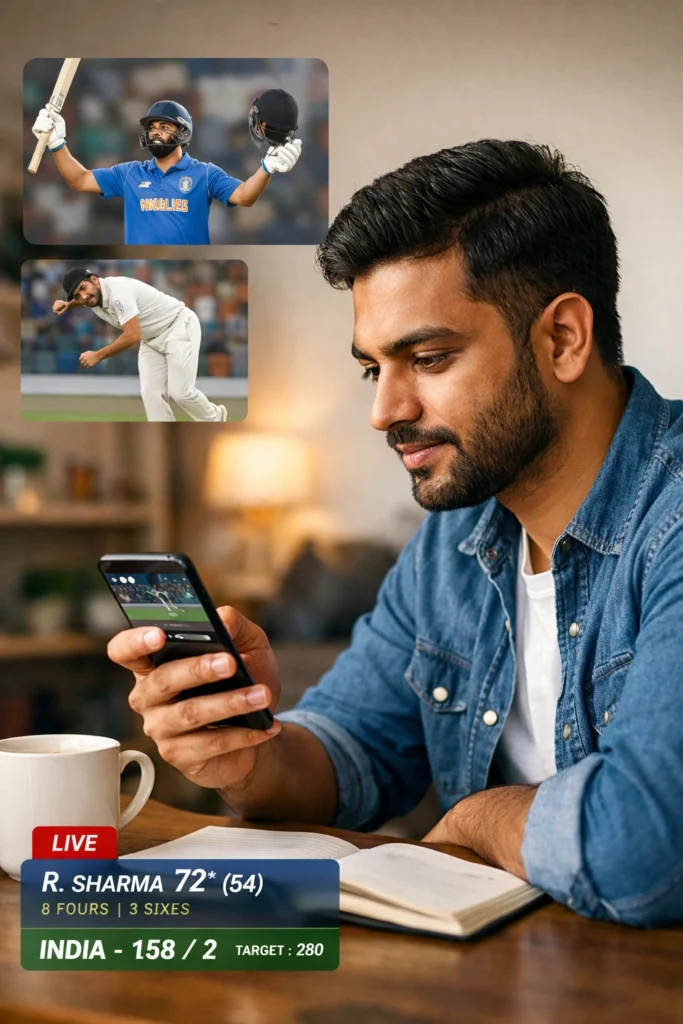
Another interesting shift is how viewers now connect with individual players rather than only teams. In earlier years, most attention stayed on the overall match result. Now many fans follow specific performances throughout the day, checking how a favorite batter builds an innings or how a bowler adjusts to conditions.
Because access is always nearby, people track progress ball by ball even while doing other things. A partnership slowly growing in the background becomes part of the day’s rhythm. The numbers update, the situation changes, and the viewer keeps returning to see what happened next.
This also affects younger audiences who discover players differently. Instead of waiting for news reports or next-day discussions, they watch development live — a newcomer handling pressure, a veteran pacing a chase, or a spinner working through a long spell. The connection feels immediate because the performance is witnessed directly rather than heard about later.
Conversations have adapted too. Rather than broad debates about who won, discussions often focus on moments: a clever variation, a patient innings, a smart field placement. People pause what they are doing, share a clip, comment briefly, and return to their routine. The interaction is shorter but more frequent.
Over time, this builds familiarity. Fans recognize playing styles, understand patterns, and anticipate decisions. Following the sport becomes less about scheduled viewing and more about ongoing awareness. The match exists in the background, ready to draw full attention whenever something important begins to unfold.
In this way, the relationship between viewer and player feels closer. Not because distance decreased physically, but because observation became continuous and personal.
Matches Became Part of Daily Routine
One subtle change many people notice is how naturally the game now blends into ordinary schedules. Instead of arranging the day around the match, the match quietly sits alongside everything else. It runs while emails are answered, during lunch breaks, and sometimes even during late-night relaxation before sleep.
This constant presence reduces the pressure to watch every moment. Viewers step in and out without feeling they have abandoned the experience. A person might follow the opening overs in the morning, ignore the middle phase during work hours, and return for the finish in the evening. Even with these gaps, the story still feels complete because updates keep the narrative clear.
The background nature of modern viewing also changes the atmosphere of tense moments. When a close finish begins, attention instantly shifts from casual awareness to full focus. People stop what they are doing, turn up the volume, and give the screen their complete attention. After the result, life resumes almost immediately.
Families experience this differently too. Instead of one television controlling the room, individuals follow the match separately while sharing reactions aloud. One person may be ahead by a few seconds, another slightly behind, yet everyone celebrates together once the outcome becomes clear.
Over time, the sport becomes less of an event and more of a companion. It fills quiet spaces in the day — the spare minutes between responsibilities — without demanding full commitment for hours. This balance allows even busy viewers to remain connected throughout a long series or tournament.
The result is a steady relationship rather than an occasional one. The game is always nearby, ready whenever attention is available.
Conversations Now Happen in Real Time
The way people talk about matches has changed just as much as the way they watch them. Earlier, discussions usually started after the game ended — at school the next morning, at work the next day, or during evening gatherings. Now reactions appear the moment something happens.
A surprising wicket or a dramatic shot quickly becomes a shared moment. Messages arrive instantly, sometimes before the replay finishes. Friends who are far apart experience the same tension together, responding within seconds even though they sit in different cities or countries.
This immediacy creates a different type of excitement. Instead of remembering moments later, viewers react while emotions are still fresh. A close decision sparks debate right away. A brilliant performance gains appreciation in real time. Even neutral spectators feel part of a larger crowd because thousands of voices respond together.
The pace of conversation is shorter but more frequent. Rather than long discussions, people exchange quick thoughts throughout the match — a prediction, a reaction, a brief joke — then return to whatever they were doing. Over the course of a game, these small interactions build a continuous social experience.
Interestingly, the sense of distance between fans has reduced. Two strangers following the same match often share similar reactions despite never meeting. The match becomes a temporary meeting point where everyone understands the same moment without needing explanation.
Because of this, watching no longer feels isolated even when done alone. The presence of others is always implied through ongoing conversation. The sport still connects people, but now the connection forms instantly rather than later.
The Experience Feels Continuous
In the past, a match had a clear beginning and end for most viewers. Once the final ball was bowled and the television turned off, attention moved elsewhere until the next scheduled game. Now the connection rarely breaks completely.
After the result, people often stay engaged a little longer. They look back at important passages, revisit turning points, or simply reflect on how the situation changed over time. The story of the match stretches beyond its actual playing hours.
Because updates and discussions continue, the sport occupies a longer space in memory. A great innings is talked about immediately, reconsidered later, and sometimes mentioned again the following day. The separation between “during the match” and “after the match” has become softer.
This ongoing presence also makes long tournaments easier to follow. Instead of isolated games, the competition feels like a single unfolding narrative. Performances build meaning gradually — a team’s form, a player’s rhythm, or a rivalry gaining intensity. Viewers carry this awareness from one day to the next without needing to reset their attention.
For many people, the game now resembles a background storyline that progresses alongside daily life. They may not watch every ball, yet they rarely lose track of the bigger picture. Important developments naturally draw them back in, while quieter periods sit calmly in the background.
The result is a smoother relationship with the sport. Rather than a series of separate events, it feels like a continuous experience that gently returns to attention whenever something meaningful happens.
Why Fans Prefer Live Cricket Online Today

The main reason viewers choose live cricket online is simple — control and instant access. With live cricket online, fans no longer depend on television schedules or specific locations. They open live cricket online anytime and immediately join the match. Whether it is the first over or the last over, live cricket online keeps them connected without delay.
Another major advantage of live cricket online is continuous availability. People can check live cricket online during short breaks, while traveling, or between daily tasks. Because live cricket online works across devices, a viewer can start watching on a phone and continue live cricket online later on another screen. This flexibility makes live cricket online the most convenient way to follow matches.
Fans also rely on live cricket online for real-time awareness. Instead of waiting for updates, live cricket online provides every ball instantly. A boundary, wicket, or review decision appears immediately through live cricket online streams and updates. This is why many viewers keep live cricket online open in the background throughout the day.
Another important factor is engagement. Live cricket online allows viewers to react while the match is happening. People discuss moments, share opinions, and return to live cricket online again within seconds. The connection feels active because live cricket online delivers events at the exact time they occur.
Over time, live cricket online has become a habit. Fans wake up and check live cricket online scores, continue following live cricket online during the day, and return to live cricket online for crucial overs. Instead of planning around matches, viewers simply keep live cricket online available at all times.
For modern audiences, live cricket online is no longer just an option — live cricket online is the primary way cricket is followed daily.
Conclusion
Cricket has always adapted with time, and the way people follow it continues to evolve alongside daily life. What once required fixed schedules and a television screen now fits naturally into small moments throughout the day. Viewers check updates between tasks, return for important overs, and stay aware of the match without interrupting their routine.
This modern style of following the game has not reduced excitement — it has spread it across the day. Fans remain emotionally involved, reacting to turning points as they happen and sharing opinions instantly. The sense of community still exists, only now it stretches across cities and countries, connecting people who experience the same moment together from different places.
Because access is constant, many platforms now work together to provide a complete experience. Viewers often move from match coverage to related information and discussions through trusted sources like kheloyaar and partner resources such as bettingidindia to stay updated and informed around ongoing games.
In the end, the heart of cricket remains unchanged. The pressure of a chase, the patience of an innings, and the unpredictability of every ball still create the same emotion. What changed is simply availability — the game is always nearby, ready whenever attention turns toward it, becoming part of everyday life rather than a separate event.
Frequently Asked Questions (FAQ)
1. What does watching live cricket online mean?
It means following a cricket match in real time through the internet instead of traditional television. Viewers can open a website or platform and see the match as it happens from any location.
2. Do I need a specific device to watch matches online?
No. Matches can be followed on phones, tablets, laptops, or desktop computers. Any device with a stable internet connection and a browser can usually access the stream.
3. Can I watch a match while traveling?
Yes. One of the main advantages of online viewing is mobility. As long as mobile data or Wi-Fi is available, the match can be followed during commuting or outdoor activities.
4. What if my internet speed is slow?
With slower connections, viewers may switch to lower video quality or follow ball-by-ball updates instead of full video. Many platforms provide both options so the match remains accessible.
5. Do I have to watch the entire match continuously?
Not at all. Many people check in during important moments such as powerplays, partnerships, or the final overs. The flexible nature of online viewing allows partial watching without losing track of the game.
6. Is it possible to follow matches without sound?
Yes. Some viewers keep the stream muted and rely on visuals or score updates, especially while working or studying.
7. Can multiple people watch the same match from different places?
Absolutely. Friends often follow the same game simultaneously from different locations and share reactions through messages or social media.
8. Are only international matches available online?
No. Depending on the platform, domestic leagues, smaller tournaments, and practice matches may also be available along with major international games.
9. Why has online viewing become so popular?
Because it fits modern routines. People no longer need to sit in one place for hours; they can stay connected to the game anytime and anywhere.
10. Does online viewing change the cricket experience?
The emotion remains the same — excitement, tension, and celebration — but the access becomes easier and more personal, allowing fans to follow matches in their own way.