
Introduction
Cricket has always been a sport built on memory. Fans remember not only scores and trophies, but also stories — the tension of a final over, the patience of a long innings, the rise of an underdog team, and the emotions tied to unforgettable matches. These memories do not survive through highlights alone; they are preserved through writing. Cricket books carry the heartbeat of the game across generations, allowing readers to relive moments long after the crowd has left the stadium.
However, behind every cricket book exists a detail most readers never notice: the Cricket Book ID. While the cover shows the title and the pages tell the story, this small identification code quietly gives the book its official identity. It separates one cricket book from another, protects its originality, and ensures it can be found, referenced, and preserved in a world filled with thousands of similar titles.
The Cricket Book ID is not part of the narrative, yet it safeguards the narrative. It allows libraries to catalogue accurately, publishers to manage editions, researchers to cite correctly, and collectors to verify authenticity. Without it, cricket literature would become a maze where history could easily be lost or confused.
Understanding the Cricket Book ID means understanding how cricket stories survive beyond time. It is the invisible structure supporting the visible passion of the sport — a silent system ensuring every cricket story remains exactly where it belongs in history.
Understanding the Purpose of Cricket Book ID
After the introduction, the next step is to clearly understand why the Cricket Book ID actually exists and what purpose it serves in the world of cricket literature. At first glance it may look like just a number printed on a page, but in reality it works as the official identity of a cricket publication.
Every year, hundreds of cricket books are published around the world. Some are biographies of famous players, some analyze tournaments, others teach techniques, and many record statistics. Titles often sound similar — for example multiple books may talk about World Cups, legendary captains, or famous rivalries. Without a unique identification system, it would become almost impossible to differentiate one book from another.
This is where the Cricket Book ID becomes essential.
The primary purpose of the Cricket Book ID is to assign a permanent and unique identity to each cricket book. No matter how similar the title or topic is, the identification number ensures that the book can always be recognized correctly. It acts like a fingerprint — no two books share the same one.
Because of this identity system, different groups benefit:
Publishers use it to manage printing and distribution.
Libraries use it to organize shelves and databases.
Researchers use it to cite exact references.
Readers use it to find the correct edition.
Collectors use it to confirm authenticity.
Without Cricket Book ID, confusion would happen frequently. A reader might order a book expecting updated statistics but receive an older edition. A researcher might quote the wrong source. A library might place a book in the incorrect category. The identification system prevents all of these problems.
Another important purpose of Cricket Book ID is long-term preservation. Cricket history stretches across centuries, and books are one of the strongest ways that history survives. By assigning a permanent identity, the system ensures that even decades later, the exact same book can be traced and verified.
So the Cricket Book ID is not only about organization — it is about reliability. It guarantees that whenever a cricket story is searched, referenced, bought, or archived, the correct book is always found.
How Cricket Book ID Works in Real Publishing Systems
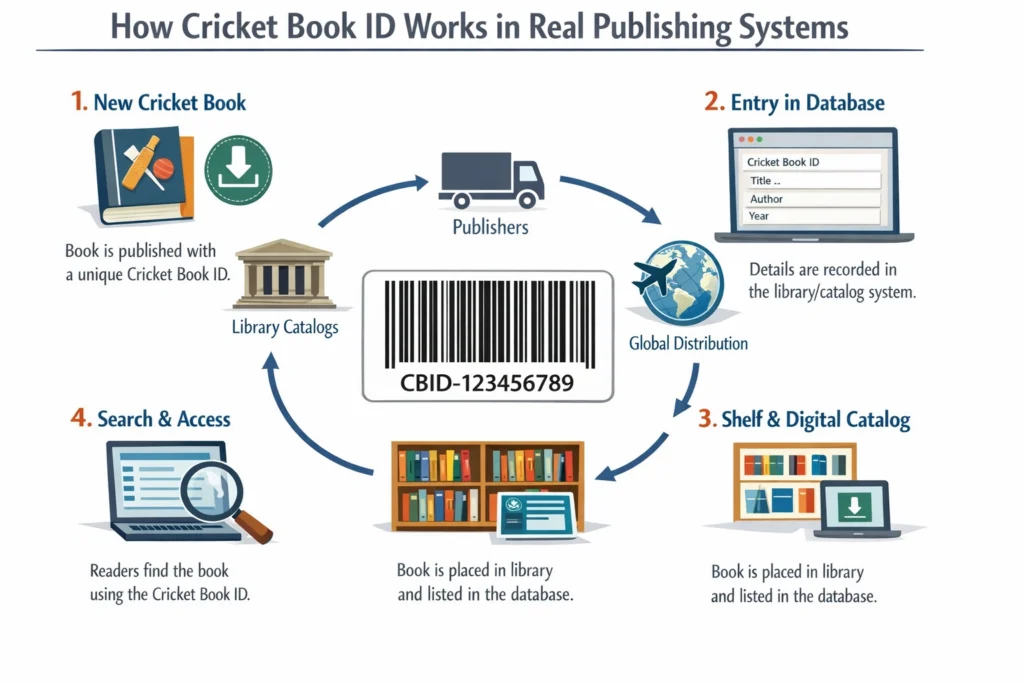
To understand the practical value of Cricket Book ID, it helps to see how it functions inside the real workflow of publishing and distribution. A cricket book does not simply move from writer to reader. It passes through many stages — manuscript preparation, editing, printing, listing in databases, shipping to stores, cataloging in libraries, and finally reaching the audience. The identification system operates throughout this entire journey.
When a publisher prepares a cricket book for release, the first step after finalizing the content is registration. At this stage, the book receives its official Cricket Book ID. This ID is then embedded into the book’s metadata — the hidden information attached to the publication. From that moment onward, every platform recognizes the book using that identity rather than just its title.
During printing, the Cricket Book ID is attached to the barcode. This barcode allows bookstores and warehouses to scan and track the book instantly. Instead of typing long titles, staff can scan once and the system immediately shows the correct book, edition, and price. This greatly reduces human error.
Next comes distribution. Books are shipped across cities and countries, sometimes in thousands of copies. Warehouses rely entirely on identification numbers to sort packages. Even if ten cricket books have similar covers, the scanning system separates them accurately because each one carries a different Cricket Book ID.
Online stores depend even more heavily on this system. When a reader searches for a cricket autobiography on an online marketplace, the platform does not rely on the title alone. It matches the search with database records connected to the Cricket Book ID. That is why customers receive the correct format — hardcover, paperback, or digital — without confusion.
Libraries also integrate the ID into catalog software. When a librarian enters the number, the entire record appears: author name, publication year, edition, and subject category. This allows readers to locate a book within seconds rather than searching shelf by shelf.
Even returns and replacements use the same system. If a bookstore sends back unsold copies, the distributor identifies them through the Cricket Book ID to update inventory records correctly.
So in real practice, the Cricket Book ID works like a communication language shared by printers, sellers, libraries, and digital platforms. Every stage of the book’s life cycle depends on it. Without this shared identification, modern publishing would slow down, mistakes would increase, and readers would struggle to obtain the right cricket book.
Cricket Book ID and Different Editions
Cricket is a constantly evolving sport. Records break, tournaments end, players retire, and new formats reshape strategies. Because of these changes, cricket books rarely remain static. Many titles are updated again and again to include fresh statistics, revised analysis, and modern perspectives. This is where the importance of Cricket Book ID becomes even more visible.
When a book is published for the first time, it receives its original identification. But if the author or publisher releases an updated version — for example adding results of a new World Cup or updated player records — the new release cannot carry the exact same identity. Even though the title looks identical, the content is different. Therefore, a modified or extended Cricket Book ID is assigned to distinguish the edition.
This distinction protects readers from confusion. A buyer looking for the latest statistics does not accidentally receive an outdated version. The identification tells whether the book belongs to the first edition, revised edition, anniversary edition, or expanded edition.
For researchers and historians, this is extremely important. Imagine quoting batting averages from a book printed ten years ago while believing it is the latest version. The information would be incorrect. Because of Cricket Book ID, scholars can reference the precise edition they used, making their work reliable and verifiable.
Publishers also rely on this separation. Sales data, stock management, and reprints all depend on knowing exactly which edition is being handled. If older copies remain unsold, they are tracked separately from new ones. Without identification, financial records and distribution would become inaccurate.
Collectors benefit as well. First editions often hold sentimental and monetary value. The Cricket Book ID allows collectors to verify whether a copy truly belongs to the original print run or a later reproduction.
In this way, the Cricket Book ID does more than identify a book — it tracks the timeline of knowledge inside the book. Each edition becomes a historical marker showing how cricket understanding evolved over the years.
Role of Cricket Book ID in Libraries and Archives
Libraries are among the most important guardians of cricket history. Long after matches are forgotten and stadiums are renovated, books remain stored on shelves and in archives. To manage thousands of sports publications efficiently, libraries depend heavily on the Cricket Book ID system.
When a cricket book enters a library, it is not placed randomly. The librarian records its identification details into a catalog database. The Cricket Book ID becomes the primary reference point that connects the physical book to its digital record. With a single search using this ID, the system instantly shows the book’s title, author, publication year, subject category, and shelf location.
This process saves enormous time. Without identification, readers would need to search manually through multiple sections to find a specific cricket title. With Cricket Book ID, they can locate it within seconds.
Archives use the system even more carefully. Some cricket books are rare — early match reports, limited edition autobiographies, or historical annuals printed decades ago. These cannot be replaced easily if misplaced. By assigning and recording the Cricket Book ID, archivists ensure each copy is tracked, preserved, and protected.
The identification also prevents duplication errors. Large libraries often receive donated books or multiple copies from different suppliers. Without checking the Cricket Book ID, the same edition could be recorded several times under slightly different names. The unique code guarantees accuracy in catalog records.
Another advantage appears during inter-library exchanges. If a reader requests a specific cricket book from another city or country, the request includes the Cricket Book ID. This removes any doubt about which exact publication is required, even if similar titles exist.
Over time, libraries become historical databases of the sport. Students, journalists, and historians depend on them to reconstruct past events. Because every book carries a permanent identity, the information they provide remains dependable. The Cricket Book ID therefore acts as a preservation tool — ensuring that cricket’s written history remains organized and accessible for future generations.
Cricket Book ID in Research and Academic Work
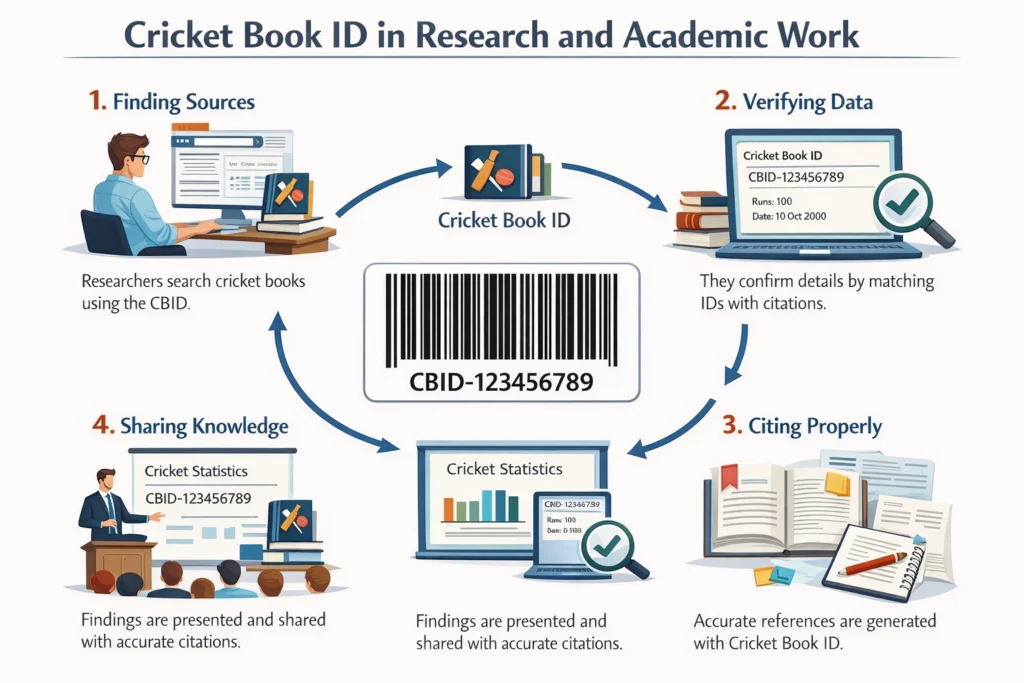
Cricket is no longer studied only as a sport; it has become a serious academic subject. Universities and scholars analyze cricket from many perspectives — history, sociology, economics, psychology, and even media studies. In such research, accuracy is everything, and this is where the Cricket Book ID becomes critically important.
When a researcher writes about a historic series or a player’s performance era, they must mention the exact source of information. Simply writing the book title is not always reliable because multiple books can share similar names or different editions. The Cricket Book ID ensures that the precise source can always be identified and verified.
For example, a scholar studying batting techniques from different decades might compare coaching manuals printed years apart. If they only cite titles, readers may not know which version was used. But with the identification number included, anyone can trace the exact edition referenced. This keeps research transparent and trustworthy.
Academic institutions also use digital databases where thousands of books are indexed. Search systems depend on unique identifiers to avoid confusion. When a Cricket Book ID is entered, the database retrieves the correct publication instantly, preventing mistakes in citations and references.
This system also protects against misinformation. Cricket statistics change frequently as records break. If a student unknowingly quotes outdated numbers, the research loses credibility. By checking the Cricket Book ID, they can confirm the publication date and ensure the data belongs to the intended time period.
Furthermore, journals and academic publishers require proper referencing standards. Including the Cricket Book ID strengthens authenticity and allows peer reviewers to confirm sources quickly. It speeds up verification and maintains scholarly integrity.
In academic environments, knowledge must be traceable. The Cricket Book ID provides that traceability. It turns cricket writing from casual storytelling into dependable documented evidence, helping cricket earn its place as a respected field of study.
Cricket Book ID and Protection of Authenticity
In the modern publishing world, one serious challenge is duplication and unauthorized reproduction. Popular cricket books — especially autobiographies, coaching manuals, and famous match accounts — are sometimes copied or reprinted without permission. This not only harms publishers financially but also misleads readers. The Cricket Book ID plays a major role in preventing such confusion and protecting authenticity.
Every legitimate cricket publication carries its registered identification. This number connects the book to official records maintained by publishers and cataloging agencies. When a bookstore, library, or buyer checks the Cricket Book ID, they can confirm whether the book is genuine or not. If the number does not match database records, the copy immediately becomes suspicious.
For readers, this means confidence. They know the content they are reading is accurate and approved, not altered or incomplete. Unauthorized copies often contain printing errors, missing pages, or outdated information. By verifying the Cricket Book ID, buyers avoid unreliable versions.
Publishers also rely on this system to defend their intellectual property. If illegal copies appear in the market, authorities can compare identification records to trace the source. Because every official edition has a registered identity, proving ownership becomes easier.
Collectors benefit as well. Some cricket books hold special value — first print runs, signed editions, or commemorative releases. Authenticity determines their worth. The Cricket Book ID helps confirm whether the book truly belongs to that limited series or is merely a reproduction.
Even online marketplaces use identification numbers to filter listings. Sellers must match database records before products are approved. This reduces fraud and maintains trust between buyers and platforms.
Therefore, the Cricket Book ID acts as a security seal. It does not only organize literature but also protects the originality of cricket stories. By safeguarding authenticity, it ensures that the history being preserved is genuine and reliable for future readers.
Global Distribution and the Universal Language of Cricket Book ID
Cricket is played and followed across many countries, and its literature travels just as widely. A book written in one nation may be printed in another and read in dozens more. Managing this international movement would be extremely complicated without a shared system of identification. The Cricket Book ID acts as a universal language understood by publishers, distributors, and libraries worldwide.
When a cricket book is exported, its title might be translated or printed in a different style for regional readers. Covers can change and even subtitles may vary, but the identification number remains constant. Because of this, a distributor in another country can immediately recognize the exact publication without depending on language or design.
International bookstores rely on this system while ordering stock. Instead of describing the book in long text, they simply use the Cricket Book ID to request it. The supplier matches the number and ships the correct title and edition. This prevents errors that could occur due to spelling differences or similar book names.
Online global marketplaces also depend on identification numbers to connect sellers and buyers across borders. A reader searching from one continent can receive the same cricket book printed elsewhere because the platform matches listings through the Cricket Book ID database. The number becomes the bridge linking different regions of the cricket world.
Libraries participate in international exchanges too. Academic institutions sometimes borrow rare cricket books from foreign archives. By referencing the Cricket Book ID, they ensure the exact document is requested and delivered safely. This keeps research accurate even when sources are scattered across continents.
In essence, the Cricket Book ID removes geographical barriers. It allows cricket knowledge to travel freely while maintaining clarity and accuracy. No matter where a book is printed or read, its identity stays consistent — making the global cricket community connected through a single standardized reference system.
The Future of Cricket Book ID in the Digital Era
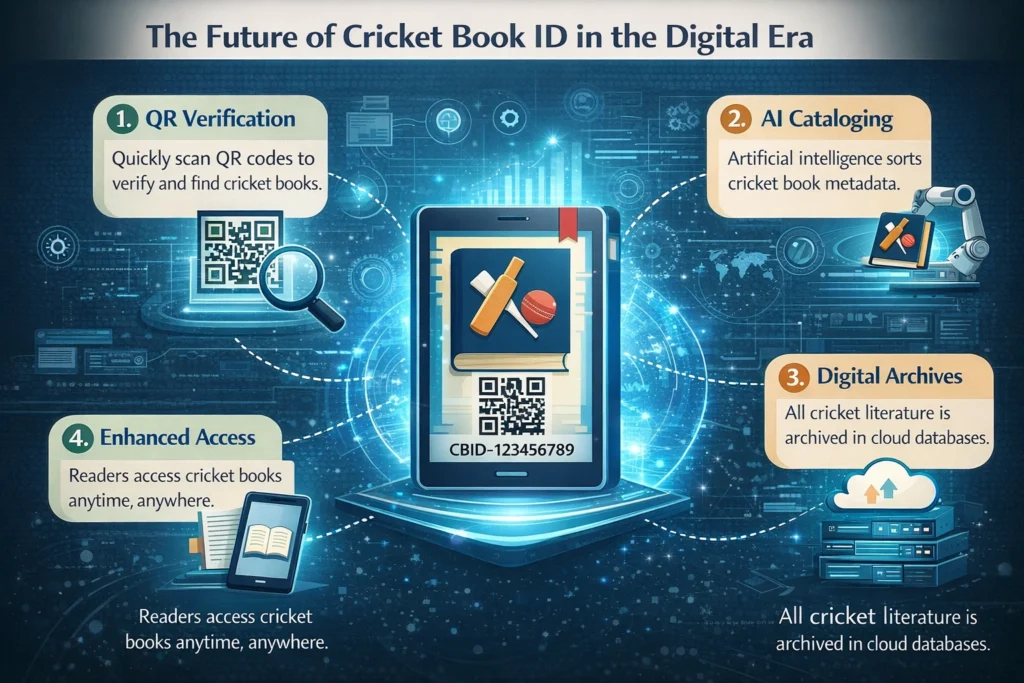
As technology advances, the way people read and store information is changing rapidly. Physical books are no longer the only medium preserving cricket knowledge. Digital libraries, mobile reading apps, and cloud archives now hold massive collections of sports literature. In this evolving environment, the Cricket Book ID is becoming more powerful than ever.
Earlier, identification mainly helped printers and libraries manage physical copies. Today, it connects entire digital ecosystems. When a cricket book is uploaded online, its Cricket Book ID links every available format — PDF, eBook, audiobook, and updated editions — into one unified record. Readers can move between formats while still accessing the same verified publication.
Future systems may integrate advanced technologies. Quick-response codes can allow a reader to scan a page and instantly view the book’s publishing history. Artificial intelligence catalogues may automatically organize cricket literature by analyzing identification data. Even blockchain verification could permanently store ownership and authenticity records, preventing tampering or duplication.
Digital preservation is another important area. Physical books can wear out, but digital archives aim to store knowledge indefinitely. The Cricket Book ID ensures that, even if files move across servers or platforms, they remain correctly identified. Researchers decades later will still be able to locate the same cricket text without confusion.
Personal reading devices may also use identification systems to recommend related material. If someone reads a biography of a cricketer, the platform can suggest other verified books connected through similar records. The Cricket Book ID therefore becomes part of intelligent knowledge networks rather than just a catalog number.
In the coming years, cricket literature will exist both on shelves and in databases. Through all these changes, the identification system will remain the constant reference point. The Cricket Book ID will continue guiding readers, publishers, and historians — ensuring that no matter how technology evolves, cricket’s written legacy stays organized, authentic, and accessible.
Conclusion: The Silent Backbone of Cricket Knowledge
Throughout the journey of cricket literature — from writing and publishing to reading and preservation — one element quietly supports everything: the Cricket Book ID. It may not be visible in match highlights or public discussions, yet it ensures that every cricket story remains organized, traceable, and authentic.
We explored how this identification system helps publishers manage editions, enables libraries to catalogue properly, assists researchers in accurate referencing, protects books from duplication, and allows smooth international distribution. In the modern era, it also connects digital formats and future technologies into one reliable record. Without the Cricket Book ID, cricket literature would become scattered, and valuable knowledge could easily be confused or lost.
Cricket survives through records, and books preserve those records beyond time. The Cricket Book ID guarantees that each publication holds its correct place in history, allowing readers years later to locate the exact source without uncertainty. Whether someone is studying the sport deeply through platforms like yoiplnews or exploring organized cricket resources on kheloyaar, proper identification keeps information dependable.
In simple words, the Cricket Book ID is the silent backbone of cricket knowledge. It may appear as a small code printed inside a book, but it carries a powerful responsibility — protecting the authenticity, continuity, and reliability of cricket’s written heritage for generations to come.
FAQs – Cricket Book ID
1. What is a Cricket Book ID?
Cricket Book ID is a unique identification number assigned to a cricket book to distinguish it from all other publications. It helps publishers, libraries, and readers recognize the exact book and edition without confusion.
2. Why is Cricket Book ID important?
It prevents mix-ups between similar titles, ensures accurate referencing, helps libraries organize collections, and protects the authenticity of cricket literature. Without it, tracking cricket books would become unreliable.
3. Is Cricket Book ID the same as ISBN?
ISBN is usually a major part of the identification system, but Cricket Book ID can also include catalog numbers, edition markers, or digital identifiers. Together they create the full identity of the cricket book.
4. Does every cricket book have a Cricket Book ID?
Most officially published cricket books have one. However, very old publications or privately printed materials may not carry a proper identification number.
5. How does Cricket Book ID help readers?
Readers can find the exact edition they want, avoid outdated copies, and confirm they are purchasing an original publication rather than a duplicate or incorrect version.
6. Can two books share the same Cricket Book ID?
No. Each Cricket Book ID is unique. It works like a fingerprint — only one specific book and edition can have that number.
7. Is Cricket Book ID useful for collectors?
Yes. Collectors use it to verify first editions, confirm authenticity, and determine the originality of rare cricket books.
8. Does Cricket Book ID matter for digital books?
Absolutely. In digital libraries and online stores, the identification system helps platforms deliver the correct eBook, audiobook, or updated version to the reader.
9. How does Cricket Book ID help researchers?
Researchers can cite exact sources, verify data accuracy, and ensure their references point to the correct edition of a cricket publication.
10. Will Cricket Book ID change in the future?
The system may integrate with technologies like QR verification, AI cataloging, and digital archives, but the purpose will remain the same — giving every cricket book a permanent, reliable identity.